THE HEAVENS ARE TELLING THE GLORY OF GOD
A Biblical Reflection on the Sacred Art at St. Patrick Church
Good morning and thank you for joining us for this half day of Lenten reflection and fellowship. As a parish community, we are preparing to celebrate our 160th Anniversary in October. It was my desire that for this anniversary, the church would be restored and renewed as a testament to founders and families who through the generations built and sustained the church and this parish. The restoration of St. Patrick Church was and is more than just maintaining the building for current and future use. It is about creating anew a sacred space where the temporal meets the transcendent, that is, the place where earth and heaven meet. This we have tried to accomplish with the added sacred art.
This doesn’t mean we leave the earth behind and step into heaven. What happens or is supposed to happen is that we find ourselves in the space between the two realms, where there are elements of both the human and the divine communicating and interacting in a dialogue of union and communion. We find an expression of this in the opening verses of Psalm 19: 1-4. Here King David” who wrote:
- The heavens are telling the glory of God;
and the firmament proclaims his handiwork. - Day to day pours forth speech,
and night to night declares knowledge. - There is no speech, nor are there words;
their voice is not heard; - yet their voice goes out through all the earth,
and their words to the end of the world.
Stars
O Lord, our Sovereign, how majestic is your name in all the earth! You have set your glory above the heavens. … When I look at your heavens, the work of your fingers, the moon and the stars that you have established; what are human beings that you are mindful of them, mortals that you care for them? Yet you have made them a little lower than God, and crowned them with glory and honor. (Ps. 8:1, 3-5)
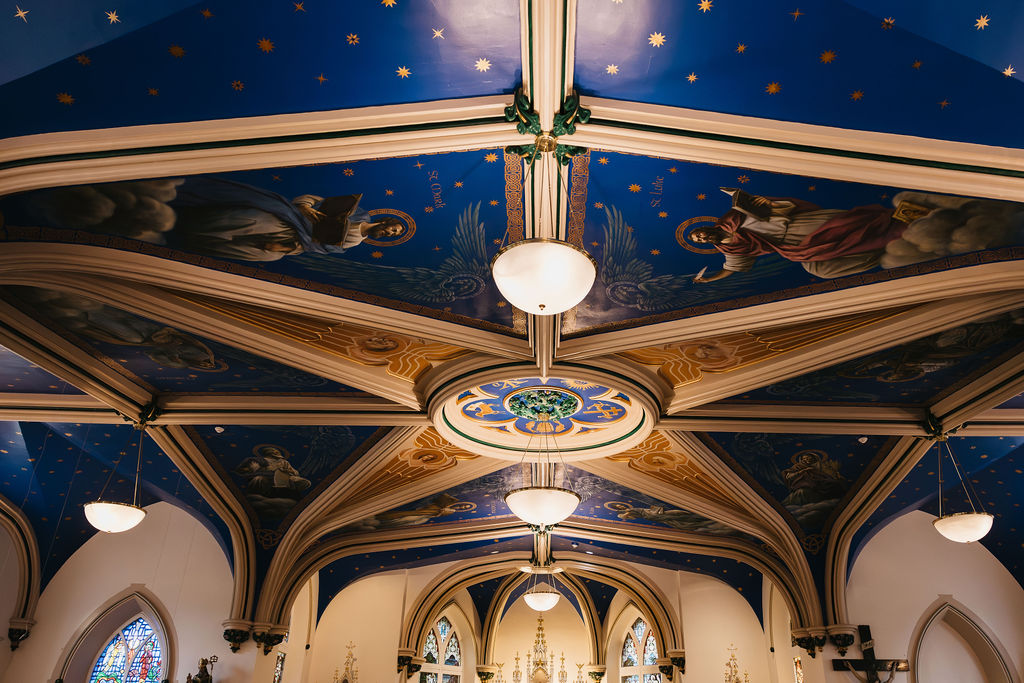
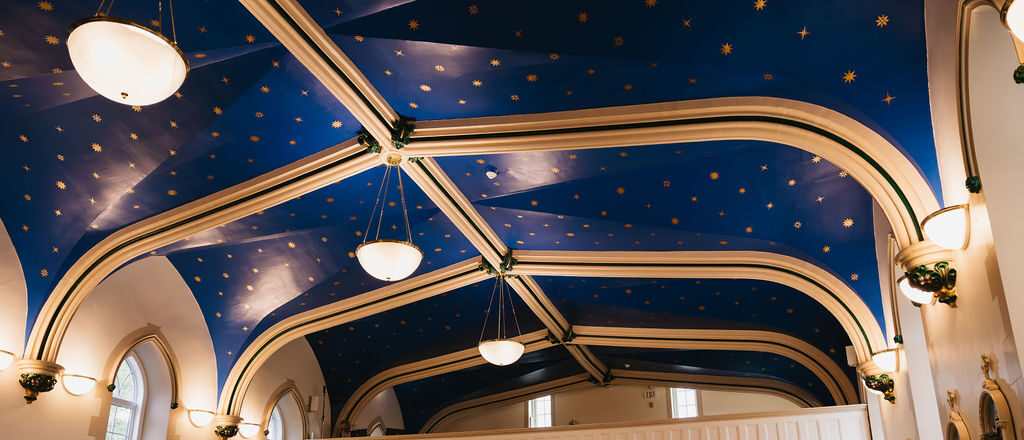
Reflection: When we look up to ceiling we see a multitude of stars, each hand painted (from stencils). The stars are in ordered lines suggesting that God’s creation follows a divinely ordained plan which is fixed or permanent. This plan we know to be our salvation in Christ.
King David, looking to the stars (more astronomy not astrology) sees in them the magnificence of God’s creative power in the vastness of the heavens and then sort of looks over his shoulder at humanity in our smallness by comparison and realizes that with the wonder of creation before him, humanity alone shares mortally in the image and likeness of God.
The Four Faces
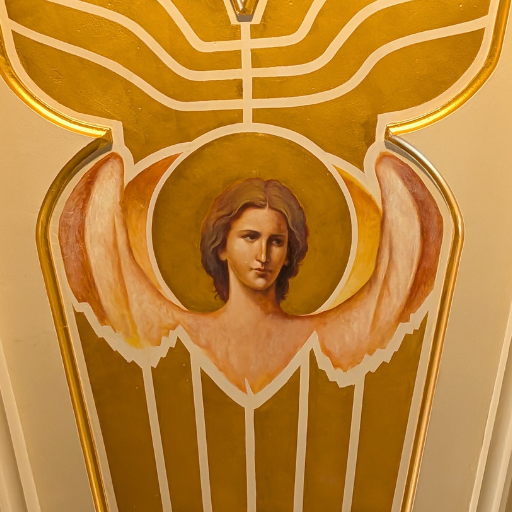
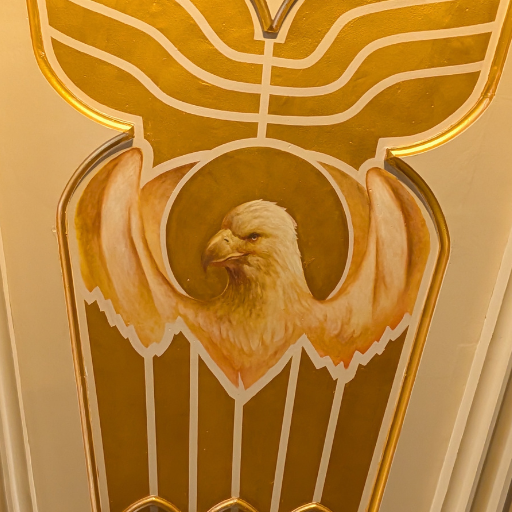
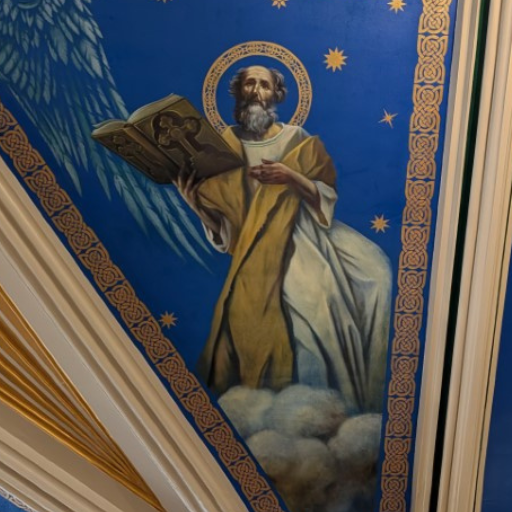
“I looked, and behold, a storm wind came from the north, a great cloud with flashing fire and brightness all around it, and something like a glowing alloy out of the fire. From within it came the likeness of four living creatures. This was their appearance: they had a likeness of a human but each one had four faces and each one of them had four wings…. The four of them had faces and wings: their wings touched one another; they did not turn when they moved; each could move in the direction of any of its faces. As for the form of their faces, each had a human face, the four had the face of a lion on the right side, the four had the face of an ox on the left side and the four had the face of an eagle. (Ez. 1:4-6, 8b-10)
Reflection: What Ezekiel is describing are the Cherubim who stand before the throne of God in the heavens and worship God continually. We too in our assembly in the church worship God and share in the heavenly worship: the “Holy, holy, holy, Lord God of Hosts” is the antiphon or chorus sung by the angels and us.
The four faces represent the highest creatures of creation, as understood in ancient times. Not just the book of Ezekiel, these faces have been interpreted by Christian scholars such as St. Augustine and St. Jerome, and we find these faces appended to human figures in the Book of Kells (ca. 800 AD).
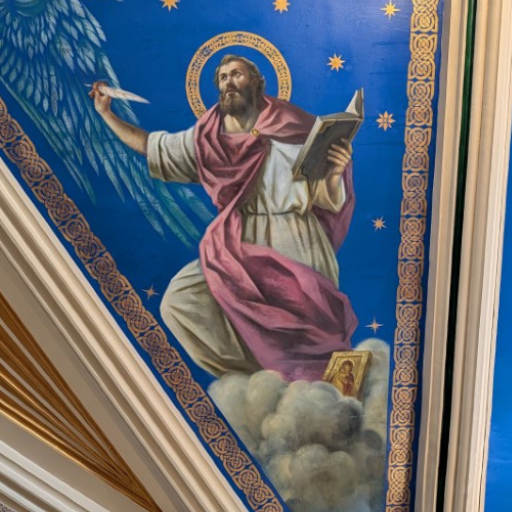
Human: Man and Woman in the image and likeness of God; Matthew – begins gospel with genealogy: Jesus = “ben Adam”
Lion: “King of the Jungle; Mark – begins his gospel with the voice crying in the wilderness
Ox or Calf: one o the sacrificial animals in the temple; Luke – begins his gospel with Zechariah the priest in the temple
Eagle: majestic and lofty in flight; John – begins gospel with reflection on the pre-existent logos immortal in the heavens




Ruth
“Why have I found favor in your sight, that you should take notice of me, when I am a foreigner?” But Boaz answered her, “All that you have done for your mother-in-law since the death of your husband has been fully told me, and how you left your father and mother and your native land and came to a people that you did not know before. May the Lord reward you for your deeds, and may you have a full reward from the Lord, the God of Israel, under whose wings you have come for refuge!” (1:10b-12)
“So she stayed close to the young women of [Boaz’s family], gleaning until the end of the barley and wheat harvests; and she lived with her mother-in-law.” (1:23)
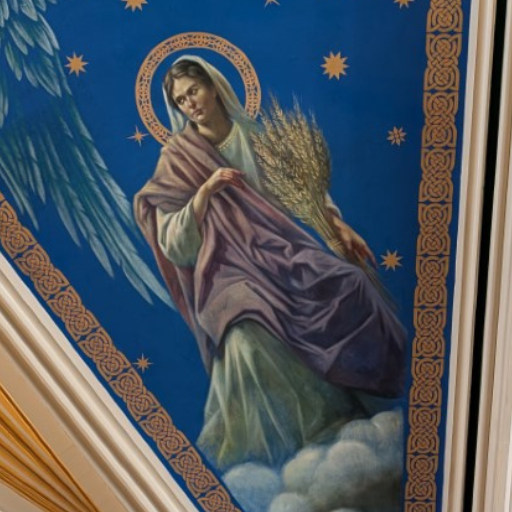
Reflection: Ruth speaks to us of faithfulness to elders, commitment, strength of character, and humility. She with her mother-in-law left her homeland (Moab) and went to live in Israel. She was gleaning the grain from the harvested fields and met Boaz who heard of her virtues. Because of her faithfulness to Naomi, Boaz chose her as his wife and she would become the great grandmother to King David.
A migrant, fleeing famine, and then settling in a new country, Ruth can speak to the Irish immigrants who, fleeing famine came to this region and in time would establish this parish.
Ruth is depicted holding a “sheaf of barley,” the offering in the temple on the day after Passover. This offering is called the “omer” and that word means “flourishing” or “abundance,” what every farmer in Fallowfield and everywhere hope for in their harvest.
David
Hear this, all you peoples; give ear, all inhabitants of the world, both low and high, rich and poor together. My mouth shall speak wisdom; the meditation of my heart shall be understanding. I will incline my ear to a proverb; I will solve my riddle to the music of the harp. (Ps. 49:1-4)
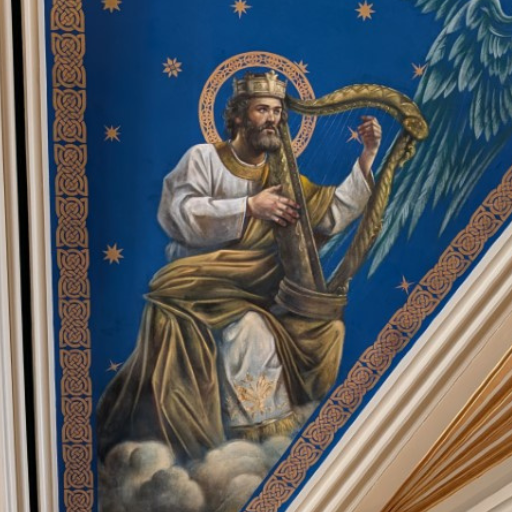
Reflection: King David came to the throne of Israel from humble beginnings: the youngest of the sons of Jesse of Bethlehem, the one sent out to tend the sheep and who probably lived “out there,” away from the family. Not descended from a line of monarchs, he was chosen by God and anointed king by the prophet Samuel. And then the adventure began.
Saul was still king, though he had been rejected by God for having rejected God’s word, and David was the chosen and anointed of God. For between 10- and 15-years Saul reigned after David was anointed. In this time David grew in knowledge and understanding, in strength and perspective. It didn’t make him perfect as a person or king but we see in David that God takes time to prepare us for the work to which we are called.
Finally, in psalm 49 we read about solving a riddle to the music of the harp. Here at St. Patrick Parish we value the role of music ministry, described by a parishioner as “a force multiplier.” This isn’t the old saying that singing is praying twice. Music in liturgy is a way not only of praying but of opening our mind and heart to the realm of the spiritual wherein we encounter God with feelings and emotions.
Isaiah and Seraphim (Angels)
In the year that King Uzziah died, I saw the Lord sitting on a throne, high and lofty; and the hem of his robe filled the temple. Seraphs were in attendance above him; each had six wings: with two they covered their faces, and with two they covered their feet, and with two they flew. And one called to another and said:
“Holy, holy, holy is the Lord of hosts; the whole earth is full of his glory.”
The pivots on the thresholds shook at the voices of those who called, and the house filled with smoke. And I said: “Woe is me! I am lost, for I am a man of unclean lips, and I live among a people of unclean lips; yet my eyes have seen the King, the Lord of hosts!”
Then one of the seraphs flew to me, holding a live coal that had been taken from the altar with a pair of tongs. The seraph touched my mouth with it and said: “Now that this has touched your lips, your guilt has departed and your sin is blotted out.” Then I heard the voice of the Lord saying, “Whom shall I send, and who will go for us?” And I said, “Here am I; send me!” And he said, “Go and say to this people ….” (Is. 6:1-9a)
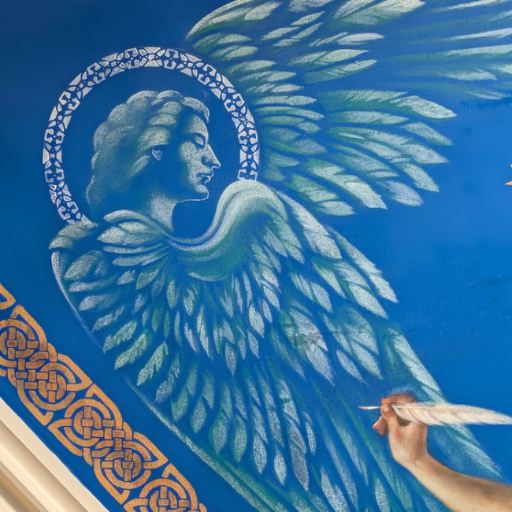
Reflection: Isaiah seeing the glory of God in the heavens, recognizes his humanity and the brokenness of the human condition. God provides a remedy for him in that moment – a purification through the agency of a Seraph. In each of the panels of the central square there is a angel with wings extended. These are the Seraphs or Seraphim who though customarily depicted with the colour red (seraph in Hebrew means fiery) we chose green as the colour to reflect St. Patrick the Irish history of the parish.
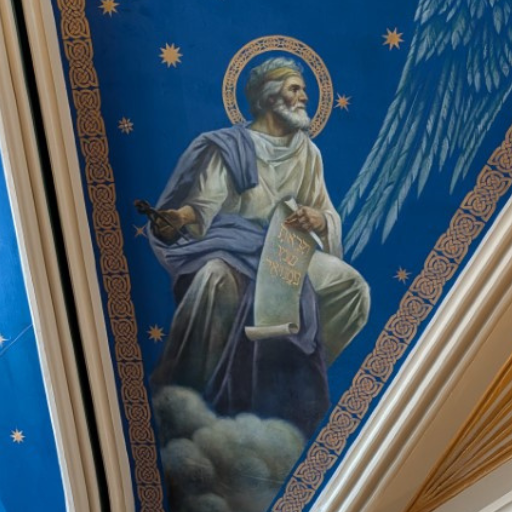
Isaiah, as seen in the sacred art, is holding the tongs with the live coal in his right hand. We then recognize that through the words of the prophet God will make know the remedy by which we are purified, and this is what is written on Isaiah’s scroll: he shall be called Emmanual. When we recognize our humanity and brokenness, which God heals through his Son we too can then say with Isaiah, “Here I am, send me.” These words of course are also foreshadowing the incarnation when God sent his Son into the world to bring us salvation by the forgiveness of our sins.
Miriam
“O my people, what have I done to you? In what have I wearied you? Answer me!
For I brought you up from the land of Egypt, and redeemed you from the house of slavery; and I sent before you Moses, Aaron, and Miriam.” (Micah 6:3-4)
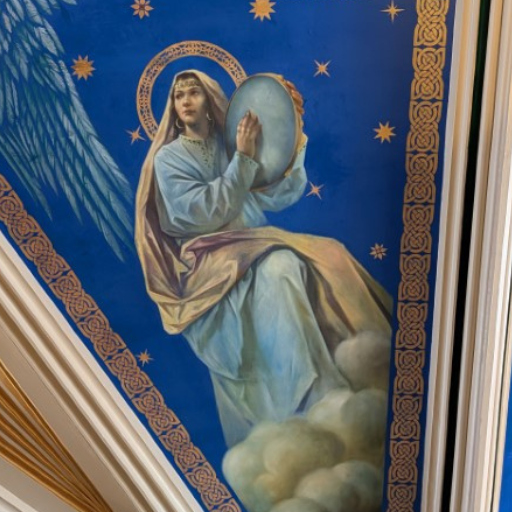
Reflection: The books of Moses (the Torah) refers to “Miriam the Prophetess” and the commentary on the Torah names her as one of the seven major female prophets of Israel. Scripture describes her alongside of Moses and Aaron as delivering the Jews from exile in Egypt: “For I brought you up out of the land of Egypt and redeemed you from the house of slavery, and I sent before you Moses, Aaron, and Miriam”. According to the ancient sources referencing this passage from Micah, just as Moses led the men out of Egypt and taught them Torah, so too Miriam led the women and taught them Torah.
In our church, Miriam is shown with a tambourine as the instrument with which she led the people of Israel in the praises of God after crossing the Red Sea. But more than just leading them in singing the praises of God, Miriam spoke God’s word to them, she taught them, and was an acknowledged leader right up there with Moses and Aaron.
Miriam inspires us to listen to God’s word and to believe that we too can speak, teach, and lead God’s people; she alongside Moses and Aaron was a prophet of the Lord and a teacher of the Law.
Center Medallion
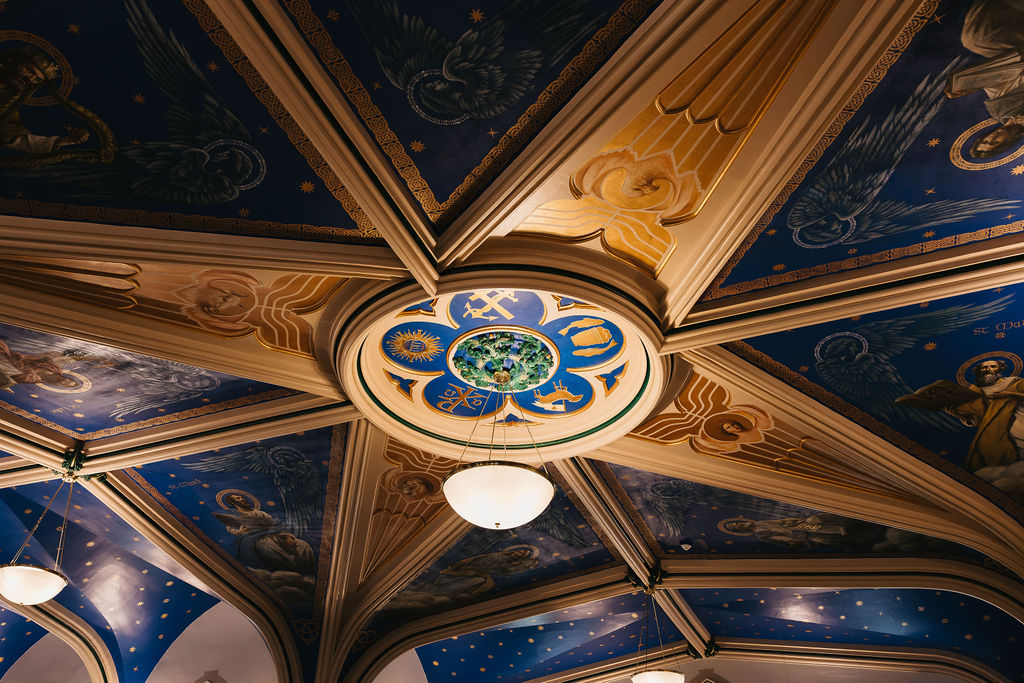
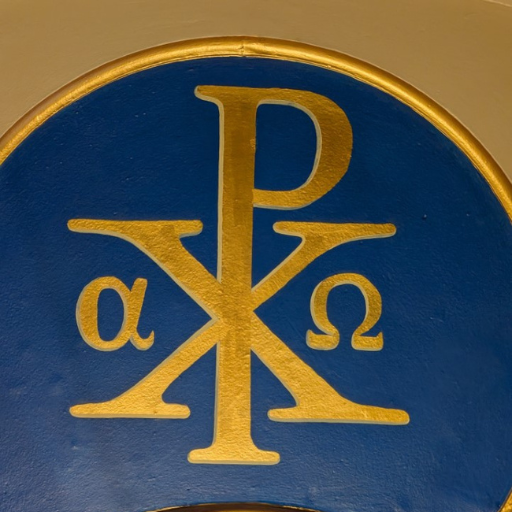
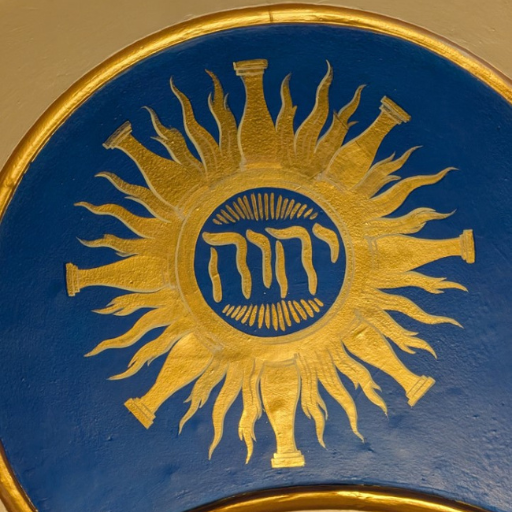
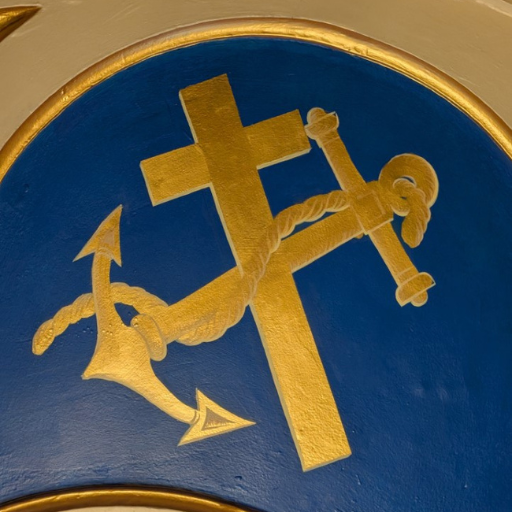
Finally, in the center medallion there are five images that speak to unseen realities. These five images are: the five loaves and two fish; the lamb with banner; the Chi-Rho; the Hebrew name of God; and the cross and anchor. These five images can speak to us of Jesus and who he is for us.
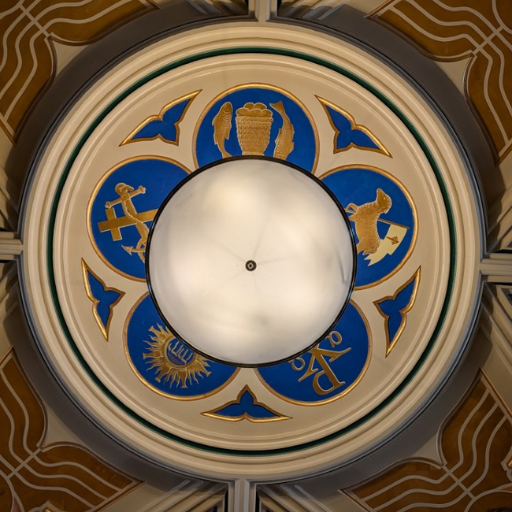
Reflection: The Five Loaves and Two Fish point us to the miracle of feeding 5000 people on the hillside. This miracle foreshadows the Eucharist where Jesus gives himself to us in bread and wine. Story: Church in Galilee and mosaic on the floor: miracle continues.
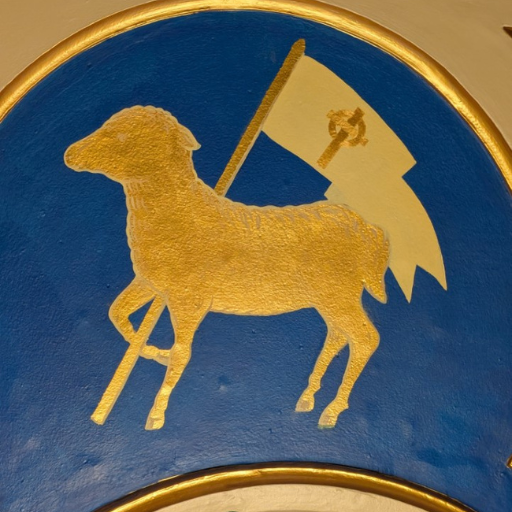
The Lamb with Banner points us to the Paschal Lamb and the Passover and the redemption from Egypt which foreshadow the Lamb of God who redeems humanity by taking away the sins of the world. The banner is the symbol of the resurrection, the Lamb once slain lives again as conqueror of death.
The Chi-Rho, you recognize this as the overlapping X and P. These are Greek letters, not Roman (which we use in our alphabet). The X and P are in our alphabet Ch and R, and so are the first letters of the word Christ. Christ or Christos shares the same root as the word anoint or anointed, which is the same word from which we get the word Messiah. One who is anointed, as we were in baptism and confirmation, is given a share in the anointing which Christ received at his baptism – the gift of the Holy Spirit. The Chi-Rho remind us that we are anointed like Christ to bring good news to others.
The Hebrew Name of God is shown as four Hebrew letters: yud-heh-vav-heh. This is known among the Jewish people as the unpronounceable name of God. It is, as God’s name, the carrier of the holiness and infinitude of divinity which is why it appears in a radiant sun. This is the personal name of God, and in Jewish tradition, these four letters are read as Adonai or Lord. For us in this church, we have this name as part of our sacred art because in the fullness of God’s self-revelation God sent his Son as our Redeemer and we know his name: Jesus. It is to him as Redeemer that every knee shall bow and every tongue profess: Jesus Christ is Lord (Phil. 2:11).
The Cross and Anchor point to the source of our salvation: Jesus’ death on the cross accomplished for us our reconciliation with God and opened for us the path to life forever in the heavens. “For the message about the cross is foolishness to those who are perishing, but to us who are being saved it is the power of God” (1 Cor. 1:18). In the letter to the Hebrews we read: “We have this hope, a sure and steadfast anchor of the soul, a hope that enters the inner shrine behind the curtain, where Jesus, a forerunner on our behalf, has entered, having become a high priest forever according to the order of Melchizedek (6:19-20). Our hope is in Christ the high priest of the new covenant, who gave his life for us and our salvation.
The Four Corners
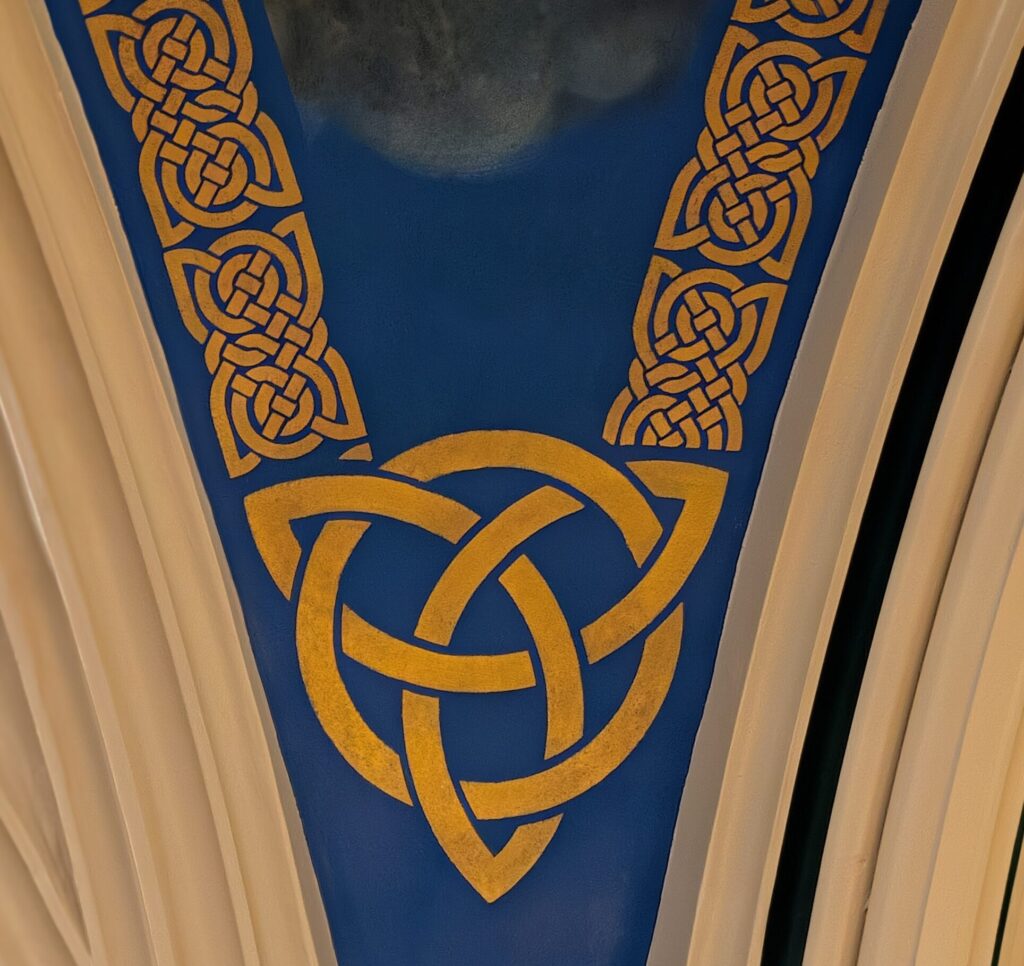
King David tells us in Psalm 19 that the heavens are telling the glory of God. We see images of that glory in the sacred art which adorns our ceiling. There is one other element that can speak to us and that is the Celtic know and overlapped circle found in the four corners of the crossing (the intersection of the nave transepts and sanctuary).
Reflection: The Celtic Knot is the trefoil or three leaf design representing the Trinity, as St. Patrick so eloquently taught. These trefoils point downward which might say the Trinity does not exist in the glory of the heavens apart from humanity. There is a divine inclination toward the created world and an invitation for the created to know the creator.
The trefoil is intertwined with a circle and a circle, in ancient art a design was a symbol of the heavens: without a beginning or an end. The trefoil in a circle speak of God’s dwelling in the heavens. But these designs are at the four corners of the crossing. Again from ancient design, the world, the earth is represented by a square, which where the expression “the four corners of the earth” finds its origin. In our church we have heaven above and earth below.
The trefoil at these four corners shows us that God who is Father, Son, and Holy Spirit is present not only in the heavens with those who are depicted in the sacred art and countless others through the ages of salvation history. God is here with us, in our world and among us in our human experience and condition.
Together with the Cherubim and Seraphim, with patriarchs and matriarchs, with prophets and kings, and apostles and evangelists we who dwell on earth are among those who dwell already in the heavens. We here join their eternal and divine liturgy in our own, adding our prayers to theirs to the glory of God. The stars in the sapphire sky bear silent witness to God’s glory.
From the stars which fill the sky with majestic beauty, “There is no speech, nor are there words; their voice is not heard.” But we who gather in this place where earth and heaven meet are one with the faithful of every age and from us today “their voice goes out through all the earth, and their words to the end of the world.”
Thank you and have a great day.